BSBKJVWEBYLTASVBBEWMBT4TDBY|HymnsMusicDonate
Menu
Theology

Total Depravity & Entire Sanctification

sermonindex Apr 19, 2007

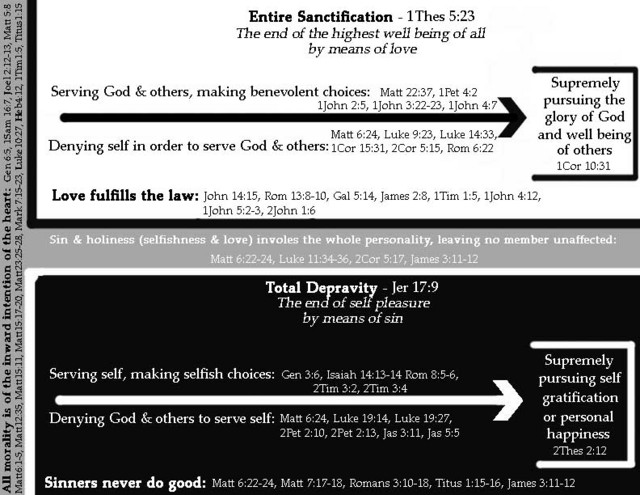
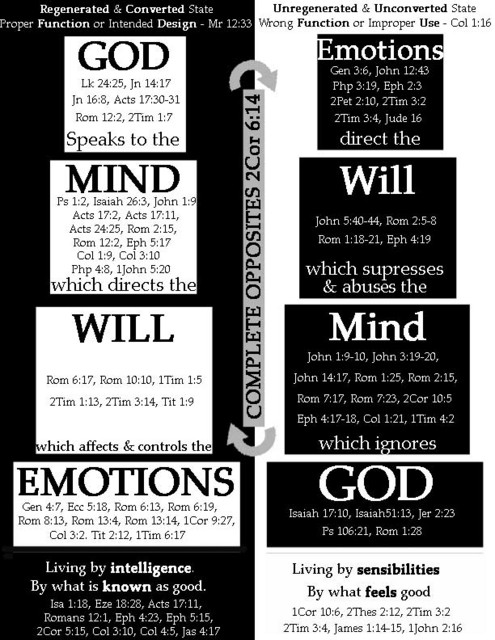
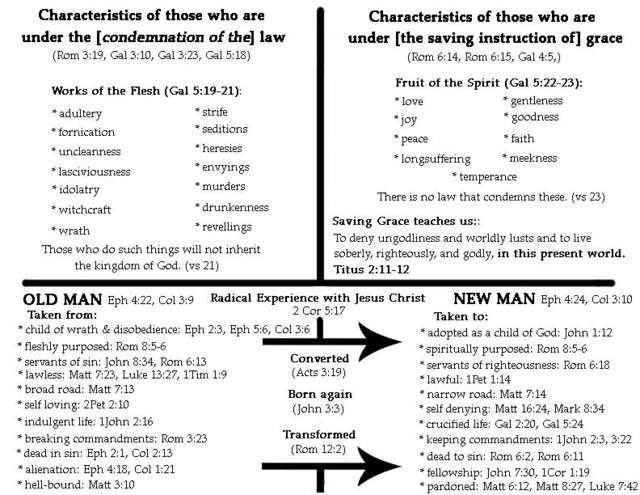
Here are some visual charts I made regarding total depravity, entire sanctification, conversion, regeneration, etc:

[b]ENTIRE SANCTIFICATION & TOTAL DEPRAVITY[/b]

http://openairoutreach.com/albums/adobe/SanctificationDepravity3.sized.jpg


[b]THE SANCTIFIED & THE DEPRAVED PERSONALITY:[/b]

http://openairoutreach.com/albums/adobe/Personality2.sized.jpg


[b]MARKS OF CONVERSION & DEPRAVITY:[/b]

http://openairoutreach.com/albums/adobe/ConversionCharacteristics3.sized.jpg

[b]
HINDERANCES TO GRACE:[/b]

http://openairoutreach.com/albums/adobe/Grace_Repentance.sized.jpg

R
rookie Apr 20, 2007

Just a thought...

Your graphs seem to point to one moment of experience in the life of a believer as the conversion which enables that person to know the things of the Spirit. There seems to be something missing in your pictorial.

Scripture points to an ongoing work of multiple experiences thoughtout ones life that changes the substance for what one hope for. We all come to Christ having been corrupted by the spirit of Satan and therefore dead sons of disobedience. All of our desires are founded on the fallen principles of this world. Thoughtout Scripture whether in the OT or the NT, the mind and heart (inward desire) are transformed in a way that points to one growing in wisdom and understanding of the ways of God. Paul is always praying for the brethren...

Eph. 1:17 that the God of our Lord Jesus Christ, the Father of glory, may give to you the spirit of wisdom and revelation in the knowledge of Him, 18 the eyes of your understanding being enlightened; that you may know what is the hope of His calling, what are the riches of the glory of His inheritance in the saints,

Col. 2:1 For I want you to know what a great conflict I have for you and those in Laodicea, and for as many as have not seen my face in the flesh, 2 that their hearts may be encouraged, being knit together in love, and attaining to all riches of the full assurance of understanding, to the knowledge of the mystery of God, both of the Father and of Christ, 3 in whom are hidden all the treasures of wisdom and knowledge.

Jer. 9:23 Thus says the LORD:
\t“Let not the wise man glory in his wisdom,
\tLet not the mighty man glory in his might,
\tNor let the rich man glory in his riches;
24 \tBut let him who glories glory in this,
\tThat he understands and knows Me,
\tThat I am the LORD, exercising lovingkindness, judgment, and righteousness in the earth.
\tFor in these I delight,” says the LORD.


Psalm 119 teaches us the many ways God reveals Himself to those who live by faith. In this Psalm we are given an example of a man who is taught by Him about His precepts, statutes, ordinances, judgements, commands, and discipline. All of these experiences are available to us as we feed on His word.


Col. 3:16 Let the word of Christ dwell in you richly in all wisdom, teaching and admonishing one another in psalms and hymns and spiritual songs, singing with grace in your hearts to the Lord.


How would you graph the parable of the sower and the seed?

God Bless
Jeff

sermonindex Apr 22, 2007

Rookie,

You are right. There is not only crisis experiences, but also daily choices. Holiness for example, is not merely a crisis decision, but a daily or momentary decision. It starts with the crisis decision, but then is continued by habitual decisions.


Here is another chart I made regarding the relation of knowledge, obligation, and blameworthiness:

Knowledge/Obligation/Blameworthiness:

http://www.openairoutreach.com/gallery/adobe/Knowledge_Guilt9?full=1


R
RobertW Apr 22, 2007

Hi Jesse,

I am wondering from the charts where you stand in contrast to Finney on the subject of regeneration? Where I have seen much good in his teachings on certain subjects I have two fundamental differences; one is that he never really believed in original sin and the other is on the subject of a believers security. Finney uses many terms that are his own or have no correlation to the scriptures so he is hard to follow. I think he needed to stick with the scriptures more. Just wondering since we have not talked in a while.

Robert

sermonindex Apr 22, 2007

I am wondering from the charts where you stand in contrast to Finney on the subject of regeneration?

[b]Regarding Regeneration:[/b]

My understanding of Finneys view of regeneration is that it was identical with conversion. But the word regeneration emphasis the work of the Spirit while conversion emphasis the work of the individual, but that the two must work together while it is the Spirit that originates the process by enlightening or convicting the mind.

Finney did not believe that regeneration was the reception of any new faculty like a free-will. He disagreed with the Calvinists notion that a sinner doesn't have the ability to obey God, that a sinner doesn't have a free-will. So they teach that regeneration, the reception of free-will, must proceed conversion, and that only God is active in regeration while man is passive, while in conversion God is passive while man is active.

But Finney believed all men already had free-will, and that regeneration/conversion has both God and man active at the same time. God teaches, man obeys. I agree with this. Regeneration is the enlightening of the mind by the Spirit while conversion is the application of the will to the Spirit's teaching. But all men already have a free-will, so regeneration is not the reception of a free-will. All men can already yeild, submit, and obey God.

Regeneration/Conversion is the pressing of the truth upon the mind by the Spirit and the will of man yeilding to this truth.

one is that he never really believed in original sin

[b]Regarding Original Sin[/b]

Finney differed both from Augustine and Pelagius on the issue of the conditions of babies.

Augustine taught that babies are evil and deserve hell from birth, but can escape hell if they are baptized.

Pelagius said babies are born completely fine, without any faults or problems from their parents.

Finney took the middle ground. Augustine said babies are evil, Pelagius said babies are good, Finney said babies are biased. Finney said that babies inherit physical depravity, or a body that is depraved with excited passions - aggrevated temptation - and is now subjected to death and disease. While moral depravity or moral character was dependant upon an individuals own free moral choices.

I agree with this. I believe we inherit a depraved body at birth, that is subjected to death and disease and influences us to sin. But we still have a free will and can choose to walk after the lust of the flesh or not.

But I do not believe that "sin" is some sort of stuff or thing that we can literally inherit, neither do I believe that anyone is held accountable or guilty for another man's sins, nor do I believe that sin is in the blood. Neither do I believe that we inherit a nature (a body) that is a sin itself, nor a nature (a body)that causes or forces us to sin.

But all sin is a voluntary choice to violate God's law, while our bodies, especially fallen bodies, is a source of aggrevated tempation. Sin is not a body, sin is not a physical thing, sin is not in our blood. But sin is a wrong or selfish moral choice.

Here is a chart I made specificly on this:
http://www.openairoutreach.com/gallery/adobe/PelagiusAugustineFinney4?full=1

and the other is on the subject of a believers security.

[b]Regarding Eternal Security[/b]

Finney believed in more eternal security then I do. Finney believed that if a Christian fell away He would not go to Heaven, but believed that a Christian would not fall away. He believed in perseverence of the Saints, that all true Saints will persevere.

Finney said that theorically if a Christian fell away, they could lose their salvation. But that in reality no true Christian actually will fall away.

I believe that the atonement of Christ makes it possible for God to conditionally forgive sin (because the severity of the blood-requirement declared the righteousness of God) but does not obligate God to automaticly forgive anyones sins (because it was not the payment of anyones debt or the exact and literal penalty of the law). Our deserved wrath was not poured out upon another (that would be unjust) but the atonement was an alternative to our punishment which makes it possible for the wrath of God to pass over all those who repent and believe.

So an individual is eternally secure so long as they are in a repentant, believing, persevering state. But if they fall into unbelief or unrepentance, they are indeed hell-bound.

L
letsgetbusy Apr 23, 2007

Wow. Sounds like I line up with Finney a good deal.

R
RobertW Apr 23, 2007

I agree with this. I believe we inherit a depraved body at birth, that is subjected to death and disease and influences us to sin. But we still have a free will and can choose to walk after the lust of the flesh or not.

How then do you reckon with Eph. 2 that tells us that there is a 'spirit' that now works in the children of disobedience and they are by 'nature' children of wrath? If it is our body that influences us to sin then Christ would have likewise had a depraved body. But these are not biblical terms so it is impossible to understand them biblically. I think there has to be a place for the influence of the spirit that now works in the children of disobedience. This is more than a physical problem it is a spiritual problem that has to be healed (Isaiah 53).


I believe that the atonement of Christ makes it possible for God to conditionally forgive sin (because the severity of the blood-requirement declared the righteousness of God) but does not obligate God to automaticly forgive anyones sins (because it was not the payment of anyones debt or the exact and literal penalty of the law). Our deserved wrath was not poured out upon another (that would be unjust) but the atonement was an alternative to our punishment which makes it possible for the wrath of God to pass over all those who repent and believe.

Oh yes, I forgot about the atonement. That was number 3. Christ's life was the propitiation for our sins. His blood takes away our sins.

1 Peter 2:24

Who his own self bare our sins in his own body on the tree, that we, being dead to sins, should live unto righteousness: by whose stripes ye were healed.

Heb. 9:28
...so Christ was offered once to bear the sins of many.

Matt. 26:28
For this is my blood of the new testament, which is shed for many for the remission of sins.
KJV

Robertson's comments on Matt 26:28, [i]He had the definite conception of his death on the cross as the basis of forgiveness of sin. The purpose of the shedding of his blood of the New Covenant was precisely to remove (forgive) sins.[/i]

If God does not automatically forgive our sin as we walk in the light then if we die with any unconfessed sin we are lost. Have you really thought through the implications of this? A person could effectively serve God their entire life and fear messing it up on the last day of their life and going to hell because of an unconfessed sin.


R
rookie Apr 23, 2007

I checked your pictorial and found that what you write is in Scripture...especially the idea that with greater understanding comes greater accountability.

The closer one gets to God the more one is subject to His law of holiness..

In generations where men were far from God, He was more merciful toward them...

1 Samuel 3:

1 Now the boy Samuel ministered to the LORD before Eli. And the word of the LORD was rare in those days; there was no widespread revelation. 2 And it came to pass at that time, while Eli was lying down in his place, and when his eyes had begun to grow so dim that he could not see, 3 and before the lamp of God went out in the tabernacle of the LORD where the ark of God was, and while Samuel was lying down, 4 that the LORD called Samuel. And he answered, “Here I am!” 5 So he ran to Eli and said, “Here I am, for you called me.”

The word of the Lord was rare in those days...and before the lamp of God went out in the tabernacle of the Lord...the Lord judged Eli and his sons for not being true witnesses of Him...

1Sam. 2:27 Then a man of God came to Eli and said to him, “Thus says the LORD: ‘Did I not clearly reveal Myself to the house of your father when they were in Egypt in Pharaoh’s house? 28 Did I not choose him out of all the tribes of Israel to be My priest, to offer upon My altar, to burn incense, and to wear an ephod before Me? And did I not give to the house of your father all the offerings of the children of Israel made by fire? 29 Why do you kick at My sacrifice and My offering which I have commanded in My dwelling place, and honor your sons more than Me, to make yourselves fat with the best of all the offerings of Israel My people?’ 30 Therefore the LORD God of Israel says: “I said indeed that your house and the house of your father would walk before Me forever.’ But now the LORD says: ‘Far be it from Me; for those who honor Me I will honor, and those who despise Me shall be lightly esteemed. 31 Behold, the days are coming that I will cut off your arm and the arm of your father’s house, so that there will not be an old man in your house. 32 And you will see an enemy in My dwelling place, despite all the good which God does for Israel. And there shall not be an old man in your house forever. 33 But any of your men whom I do not cut off from My altar shall consume your eyes and grieve your heart. And all the descendants of your house shall die in the flower of their age. 34 Now this shall be a sign to you that will come upon your two sons, on Hophni and Phinehas: in one day they shall die, both of them.

And for those who lived in a generation where God was speaking to them day by day...

Lev. 9:22 Then Aaron lifted his hand toward the people, blessed them, and came down from offering the sin offering, the burnt offering, and peace offerings. 23 And Moses and Aaron went into the tabernacle of meeting, and came out and blessed the people. Then the glory of the LORD appeared to all the people, 24 and fire came out from before the LORD and consumed the burnt offering and the fat on the altar. When all the people saw it, they shouted and fell on their faces. 1 Then Nadab and Abihu, the sons of Aaron, each took his censer and put fire in it, put incense on it, and offered profane fire before the LORD, which He had not commanded them. 2 So fire went out from the LORD and devoured them, and they died before the LORD. 3 And Moses said to Aaron, “This is what the LORD spoke, saying:
\t‘By those who come near Me
\tI must be regarded as holy;
\tAnd before all the people
\tI must be glorified.’ ” So Aaron held his peace.

This precept is woven throughout Scripture...

God Bless

Jeff

R
rookie Apr 23, 2007

Eph. 2:1 And you He made alive, who were dead in trespasses and sins, 2 in which you once walked according to the course of this world, according to the prince of the power of the air, the spirit who now works in the sons of disobedience,

"The spirit" contained within these verses refers to the devil if I read this Scripture correctly. What does Finney say of our former father the devil of whose sons we once were?

In Christ
Jeff

sermonindex Apr 24, 2007

What does Finney say of our former father the devil of whose sons we once were?

My understanding is that Jesus said a child is like his father. The devil was our Father because we did his will. But now God is our Father because we do His will.

The demonic spirit's used to work to decieve us, to sin and to sin, and these spirits still work with the children of disobedience, but now we are lead by the Holy Spirit, who is the Spirit of truth.

If God does not automatically forgive our sin as we walk in the light then if we die with any unconfessed sin we are lost. Have you really thought through the implications of this? A person could effectively serve God their entire life and fear messing it up on the last day of their life and going to hell because of an unconfessed sin.

Brother, I understand that you grew up around moral government theology. But it is possible that some of what you were taught as "moral government" was not the actual teachings of Finney.

Finney did not believe that if you have one unconfessed sin you went to hell and neither do I. Sin is not merely an outward executive action, but sin is a condition of the heart or a state of the will, when a persons intention is to serve self rather then to love God and neighbor.

So since sin is not merely an outward executive action, but an inward intention (hense the pharisees were outwardly righteous but inwardly full of iniquity because they did "righteous" things with selfish motives) the forsaking of all sin in general is required for forgiveness, but not the confession of all sins in particular, for that would require perfect memory. So true repentance is general repentance, when a person turns from all sin at once, but forgiveness does not require the confession of each and every individual sin that has ever been committed, that would be impossible.

God automaticly forgives those who repent and believe. But nobody is forgiven until they repent and believe. Only repented sins are forgiven, because only repented sins are forgivable.

(PS. If the death of Christ was the payment of everyones debt, then everyone is forgiven because everyones debt is paid. But the bible says not everyone makes it to heaven. So either Christ did not die for everyone, either he didn't pay for everyones debt, or his death was simply not the payment of debt or the reception of punishment, but was an alternative to it.)

Wow. Sounds like I line up with Finney a good deal.

Yea me too. I had heard a lot of bad things about "Finney and his theology" which to me meant it was either bad or really good. But when I started reading him for myself, I thought it was awesome, spiritual, and totally scriptural.


How then do you reckon with Eph. 2 they are by 'nature' children of wrath?

Here is a tract I wrote started with Ephesians 2:3

[b]SINNERS BY CHOICE OR BY CONSTITUTION?[/b]

May you know the truth and may the truth set you free! (John 8:32)

Merriam-Webster’s 11th collegiate dictionary defines:

Choice: “the act of choosing: selecting; power of choosing: option.”

Constitution: “the physical makeup of the individual especially with respect to the health, strength, and appearance of the body. The structure, composition, or physical make up, or nature of something.”

Do individuals become sinners by their own personal, moral choices? Or do individuals become sinners by their inherited physical constitution? The answer to such a theological question is of vital importance, as it directly affects the way we view sin and sinners; God and His government; the wisdom or reasonableness of God‘s requirements and the justice of His wrath.

Choices are voluntary, inherited constitutions are involuntary. Choices are optional, inherited constitutions are unavoidable. If it’s by inherited constitution that individuals become sinners, then it’s not by choice. If it is by choice that individuals become sinners, then it is not by constitution. If it’s by necessity, then it is not by liberty. And if it is by liberty, then it is not by necessity.

Those who have advocated a constitutional sin often attempt to use Ephesians 2:3 in support of their doctrine: Eph 2:3 “Among whom also we all had our conversation in times past in the lust of our flesh, fulfilling the desires of the flesh and of the mind; and were by nature the children of wrath, even as the others.”

Here is some awesome information. The Greek word for “by nature” is “phusis”. The English translations divide “phusis” into two words, “by” and “nature” but in the Greek it is one word. Strong’s says “phusis” can properly and accurately be translated as “use constitution” or “usage nature“ or simply “by nature“.

In context of the whole verse this passage means that those who choose to walk after “the lust of our flesh“, to gratify “the desires of the flesh“, are therefore children of wrath “by nature”, that is, they are children of wrath because of their usage of their constitution, because of the usage of their nature. “Children of wrath” (Eph 2:3) are very simply “children of disobedience” (Eph 2:1) who are wrongly using their constitutions.

Only what is physical, our fleshly bodies, is hereditary. (Gen 1:21, 1Cor 15:38-39, Heb 2:14) While we inherit our physical bodies from our parents, which are now subjected to death and disease because of Adams sin (1Corinthians 15:21-22), we do not inherit our parents guilt. (2Kings 14:6, Deu 24:16, 2Chr 25:4, Eze 18:2-4, Eze 18:19-20) Neither do our souls come from our parents but rather our souls come directly from God in it’s spiritual condition. (Ezekiel 18:4) That is why a child is neither guilty of evil nor praiseworthy of good until he himself is born and make’s his own choices. (Rom 9:11) And so each man is responsible for “the things done in his body”, and is judged “according to that he hath done, whether it be good or bad”. (2Cor 5:10) In punishment or reward, it is all according to their own works. (2Cor 11:15, Rev 22:12)

The flesh has lusts, cravings, or desire, which can be gratified through the forbidden means of sin. (Gen 3:6) These lusts are at first involuntary lusts, cravings, or desires, being strictly physical and not moral. There are involuntary physical desires and then there are intentional committals of the will. One is involuntary while the other is intentional. The former is physical, the latter is moral. But involuntary physical impulses do not bring forth moral (or immoral) sin until the will selfishly serves them supremely (James 1:15) instead of self sacrificially serving the highest well-being of others. (Luke 10:27). Physical temptation becomes immoral sin when the will yields itself to it.

It was the natural, physical lusts, cravings, or desires of the flesh which were the source of temptation for Eve in the Garden. (Gen 3:6) She “saw that it was good for food”, “pleasant to the eye”, and “desired to make one wise”. These were all natural, physical appetites for food and wisdom which she sought to gratify through sin or disobedience to God. This was the first case in history when a human being submitted their will to serve their flesh supremely rather then submitting their will to the truth of God revealed to their minds. This was the first case in the history of a human individual doing what feels good over against what she knew was good. And this is exactly what every sinner does.

Sin is a corruption of yourself or a personal choice to corrupt yourself. (Exo 32:7, Deu 9:12, Deu 32:5, Jdg 2:19, Hos 9:19) Sin is a corruption of what was meant to be good. (Gen 1:31) Walking in the flesh bears fruit unto death. (Rom 7:5) The fleshly lusts wage war against the soul. (1Peter 2:11) To be carnally “minded“ (phronema = purposed), is death. But to be spiritually “minded“ (phronema = purposed), is life and peace. (Rom 8:6) Those who are carnally purposed, “do mind [phroneo =interest oneself in] the things of the flesh; but they that are after the Spirit [interest themselves in] the things of the Spirit. (Rom 8:5)

The lust of the flesh, or desires of the sensibilities, are the source of temptation for sin. (Rom 7:21) Sin consists in selfishness which is being self-purposed, self-interested, self-serving or self-willed. (Isaiah 14:13-14, 2Peter 2:10) This is when one’s will is for their own happiness supremely. But the revelation of moral truth presented to the mind or intelligence, as revealed by the Spirit of God, is an influence towards obedience and submission. (Rom 7:12-13) Obedience consists in being self sacrificial, God-purposed, God-interested, God-serving, or God-willed. (Luke 9:23) This is when one’s will serves God and not self. (2Cor 5:15)

The demands of the flesh as imposed by the sensibilities and the demands of the Spirit as presented to the intelligence are contrary on to another, being hostile towards each other, being at an antithesis. (Rom 7:23) The former demands self indulgence and self-service supremely, the latter demands self denial and God-service supremely. (Rom 7:25)

“Neither yield ye your members as instruments of unrighteousness unto sin: but yield yourselves unto God, as those that are alive from the dead, and your members as instruments of righteousness unto God.” (Rom 6:13) The physical constitution of man is a mere tool or an “instrument” without any inherit moral character in and of itself. The body is properly and strictly neither moral nor immoral, good nor bad, sinful or holy, in and of itself apart from it’s usage as controlled by the human will. As a tool or “instrument“, the body or “members” can be an “instrument of sin” or an “instrument of righteousness“, depending on what the human will “yields” it to. (Rom 6:13)

“As ye have yielded your members servants to uncleanness and to iniquity unto iniquity; even so now yield your members servants to righteousness unto holiness.” (Rom 6:19) “For he that sows to his flesh shall of the flesh reap corruption; but he that sows to the Spirit shall of the Spirit reap life everlasting.” (Gal 6:8)

Christians still live “in the flesh” (2Cor 10:3), but they do not live “according” to it. (2Cor 10:2) The physical body that Christians have is the same exact physical body they had when they were children of wrath (Php 3:11-12), and it will remain the same exact body until they die (2Peter 1:14) until the resurrection when they receive a glorified body. (1Cor 15:53-54) While the constitution itself is the same, the usage of the constitution has changed. Christians have obeyed the command to “present your bodies a living sacrifice, holy, acceptable unto God, which is your reasonable service” (Rom 12:1). “And they that are Christ’s have crucified the flesh with the affections and lusts.“ (Gal 5:24) Christians are those who “let not sin reign in” their “mortal body” to “obey it in the lusts thereof”. (Rom 6:12) Christians have gone from being governed by the flesh (Col 3:7) to being governed by Christ. (Col 1:13) They have cleansed themselves from the filthiness of the flesh. (2Cor 7:1)

Sin is when the will is submitted to the sensibilities, to the lusts, desires, or affections of the flesh (IJohn 2:16), over against the moral demands of God clearly perceived by the mind. (John 1:9, John 16:8) Sinners do what “feels good,” seeking their own pleasure and happiness as the end in which they are in pursuit. But obedience is when the will is submitted to what is “logikos“ or “reasonable“ or “rational“, when the will performs it‘s “reasonable service“. (Rom 6:13) This is when a sinner comes unto God to “reason together” (Isaiah 1:18), when he comes to his senses (Luke 15:17), when the sinner “considers and turns” (Eze 18:28) when the will submits to the intellect, or to the moral truth of God which the Spirit reveals to the Mind. (Acts 17:11)

Christians do what they “know is good” for the glory of God and the well-being of others. (Matt 22:37) Those who walk in the Spirit do not fulfill the lusts of the flesh. (Gal 5:16) A single individual cannot serve both the flesh and the Spirit, serve both self and God, or serve any two Masters at the same time. (Matt 6:24, James 3:11) It is by willfully escaping “the corruption that is in the world” that comes by obeying “lust“, by yielding unto the moral demands presented by the Spirit, that we become “partakers of the divine nature“. (2Peter 1:14)

The bad nature (or old man, Rom 6:6, Col 3:8-9) is when you submit your will to the sensibilities (Eph 4:22), when you use your body as an instrument for sin. (Rom 6:13) But the divine nature (or new man, Eph 4:24, Col 3:1-2, Col 3:12-14) is when you submit your will to your intellect (Col 3:10), when you use your body as an instrument for righteousness. (Rom 6:13) This is when a person “does by nature the things contained in the law.” (Rom 2:14)

The mind was designed to receive revelation or moral truth from the Spirit of God. (Rom 2:15) The will was designed to be under submission or obedience to the mind, to obey it‘s moral demands. (Rom 6:17) And the sensibilities were meant to serve the will and mind, to wholesomely and wonderfully experience and enjoy life. (Ecc 5:18, 1Tim 6:17) The will was always suppose to rule over the sensibilities. (Gen 4:7) But sinners have established the gratification of the sensibilities as supreme, having subjected the will to be in submission or obedience to the impulses and pleasures of the sensibilities. (Php 3:19) And they have suppressed in unrighteousness the truth of God as revealed to the mind. (Rom 8:1, 2:8; 2Thes 2:10, 2:12). And so sinners have “perverted that which was right” (Job 33:27), using for evil what was intended for good.

Sinners are enemies of God through wicked works (Col 1:21), because they are obeying the “lust of the flesh” or wrongly using their natures, constitutions, or faculties (Eph 2:3). Because sinners have indulged the flesh, rather then mortify it’s members, they have come under the wrath of God. (Col 3:5-6)

All sin in essences consists in a wrong moral choice (1John 3:4) to serve self as opposed to serving God‘s glory and the well-being of others (Luke 10:27). This is why there is no scriptural reason for any sort of “physical” regeneration in this life in order to be saved, because there is no such thing as “physical” sin, but only a physical temptation which attempts to direct the will. (Gal 4:14, James 1:14) The flesh, with it’s lusts, is the source of temptation, but it is not sin itself. And so the body does not need to be removed before we can be saved, or before we can have victory over sin in this life (Gal 1:4), but rather God’s grace teaches us to ‘deny ungodliness and worldly lust” that we would be “godly in this present world”. (Titus 2:12) And so Christians are to glorify God while in their physical bodies. (1Cor 6:20) Whether absent or present in the body they are to be acceptable unto God. (2Cor 5:9)

Rather then a physical regeneration, the Spirit of God brings about a “moral” regeneration at conversion (2Cor 4:16), because all sin is a moral choice, all sin consists in sinning. (1John 3:4) Sin is willful rebellion against what the mind knows is right, against perceived moral knowledge. (Heb 10:26, James 4:17) Sin is always avoidable, always being optional. (1Cor 10:13) The Spirit changes our will (Eze 18:31, 36:26), not by force or by might, but through the influence of truth upon the mind by the Spirit (John 6:44, John 12:32, John 17:19, Titus 3:5), so that we can be saved in this life. (1John 3:14) And when God changes man's will, the whole man is changed and he is a new creature! (2Cor 5:17)

But the Spirit does not change our physical bodies, in this life, in order for us to be saved. Conversion is not the reception of any new faculties, but it is the proper use of the present faculties. (Rom 6:13, 6:19) Christians are spiritually, not physically, transformed in this life. (Rom 12:2) This is truly what it is to be “born again” (John 3:3) or to be “born of the Spirit”. (John 3:6) And we will receive a glorified body, which is not subjected to death and disease, in the next life. (1Cor 15:42, Php 3:21)

The choice to serve the lust of the flesh unto death or to obey the truth of the Spirit unto life is freely yours. (Deu 30:19, Gal 6:8) Turn from the idol of self unto the living God! (Thes 1:9) If you turn away from all wickedness and do what is lawful and right, God will forgive you instead of punished you. (2Chron 2:14, Eze 33:13-14) If you repent, God will give you mercy and grace because of Jesus Christ. (Acts 2:8) Those who submit their will to the Spirit, rather then the flesh, have no condemnation in Jesus Christ. (Rom 8:1) Those who obey Christ from the heart have eternal salvation. (Heb 5:9, Rom 6:17) Christ was crucified for you and rose from the dead that you might be forgiven. (Matt 16:21, 1Peter 2:24) But you must “obey the truth” to have forgiveness in Christ. (Gal 3:1) You must die to self-will. (1Cor 15:31) You must crucify your flesh. (Gal 2:20, Gal 5:24) You must forsake all. (Luke 14:33) You must deny yourself. (Matt 6:24, Mark 8:34, Luke 9:23) And you must follow Christ. (John 10:27) Choose you this day who you shall serve! (Joshua 24:15)

sermonindex Apr 24, 2007

[b]Now I understand Augustines Original Sin
[/b]

My wife and I are working with a spanish Lutheran Pastor who is helping us to the legal paper work for Krista's perminant residency in America. (She is a Canadian).

We were in his office yesturday and during a break I started to look at some of the Pastors books. I found a Lutheran "Christian Dogmatics" volume set.

I reviewed it. It was typical Augustinian and Lutheran. I read a quote from Luther on the atonement, "if you deny that Jesus Christ became a sinner, you might as well deny that He was crucified, died, and rose again...He took our original sin and we took his sinlessness." (That is a debate for another thread)

But I found a quote from Augustine that cleared up my whole understanding of his teaching! I hear from many people that "we inherit sin at birth" but nobody has ever been able to answer "which sin do we inherit?". Finally, Augustine answered my question!

Augustine believed that we inherited concupiscence or desires (like sexual desires) from Adam which are sin themselves. Augustine did not believe that Adam and Eve had sexual desires before the fall. He had an arguement as to how they were going to populate the planet without sexual desire, but I do not know his arguement.

Anyways, Augustine taught that involuntary lusts, cravings, and desires were not temptation but were sin themselves. And so we inherit sin because we inherit desires or lusts like sexual desires.

This is what I have found with others who believed in original sin like Edwards and even Samuel Brengle.

Edwards, after the teachings of John Lock, only believed that man was made of two parts: Will and Intellect. He did not believe in a seperate faculty of emotions, but that Emotions or desires fell under the Will. So a physical attraction is adultery.

Samuel Brengle, who believed in second blessing holiness (when original sin is supposedly removed), taught that if you are not sanctified you will have fleshly cravings or physical desires. But when you are sanctified, those cravings and desires are gone.

Many theologians did not make a distinction between metaphysics and ethics, between involuntary cravings and voluntary committals of the will. But Finney, with his distinct lawyer mind, did make that proper distinction.

I agree with Finney that Adam and Eve were given natural desires which could be satisfied lawfully or unlawfully. And we inherit an aggrevated temptation, or aggrevated lusts, but that these are not sin in and of themselves. Rather, physical lusts, cravings, and desires are temptation. But these physical temptations because immoral sin when the will voluntarily submits to them, gratifies them unlawfully, and serves them supremely.

Physical lusts, which are truly hereditary, are not sin themselves but are temptation. A crack baby is not only a perfect illustration, but a crack baby is the point itself. A baby who had a drug abusing parent is born with physical desires for that drug. But the baby is not guilty of the parents sin just because it inherits the parents physical desires. Rather, only when the child knows right from wrong, and chooses to serve the flesh over the Spirit, is it then morally guilty.

What is physical is not moral, and what is moral is not physical. All morality is of the inward intention of the heart, or of the committal of the will, but not a physical body. Your body (nature) cannot be sinful. It can be a source of temptation, but not sin itself.

And one last point I've been pondering. Sin is not merely an outward executive action. But sin is a state of the will, a condition of the heart. Sin is when a persons heart intention is to serve themselves, to serve their sensibilities, but righteousness is when the hearts intention is to serve God, to submit to the truth of God revealed to the intelligence by the Spirit. Sin and righteousness do not consist in mere outward executive actions, but sin and righteousness consist in a state of being, in a state of the will or of the heart.

And unless you decide it, it is not your decision. Unless you originate the willing, it is not your will. So each man originates his own sin.

The bible makes a distinction between natural lust and voluntary sin. It says that there is a lust which comes before sin:

[b]Jas 1:15[/b] - Then when [b]lust[/b] hath conceived, it bringeth forth [b]sin:[/b] and sin, when it is finished, bringeth forth death.

R
RobertW Apr 24, 2007

Your body (nature) cannot be sinful. It can be a source of temptation, but not sin itself.

So do you believe in Original Sin as it pertains to [i]pollution[/i] but not [i]guilt[/i]?

Pollution only makes one [i]bent[/i] towards sinning. When I say Sin Nature- that is what I mean- [i]bent[/i] towards sinning. Not that having the Sin nature means I have sinned- it means I had a nature to commit sins. This does not mean I was not in control of my actions and could not have chosen otherwise. I am not 'forced' to sin by the Sin nature- I am 'tempted' to commit sin by the sin nature and that nature is within because I was 'in Adam' and the Body of Sin. Now I am under the Last Adam and am in the "Body of Christ." God now works in me both to will and to do His good pleasure.

Your findings on lust being sin are interesting. It is commonly known that sexuality became taboo for a long time but this was never a biblical teaching. Song of Solomon is proof enough for that. God would not articulate the process of being in love within the context of marriage if it was sinful. Some even thought it a sin to look on their own nakedness.


R
RobertW Apr 24, 2007

Finney did not believe that if you have one unconfessed sin you went to hell and neither do I. Sin is not merely an outward executive action, but sin is a condition of the heart or a state of the will, when a persons intention is to serve self rather then to love God and neighbor.

Maybe I could ask the question a little differently. If a person yields to the lust that is in them and commits a sin- does that sin put their soul in danger right then and there? Are they in a state of being lost until they confess that sin?

sermonindex Apr 24, 2007

So do you believe in Original Sin as it pertains to pollution but not guilt?

Pollution only makes one bent towards sinning

It seems that what you call pollution is what Finney taught as physical depravity. We inherit a physically depraved body, with aggrevated lusts, which bends us or biases us towards sin. But that the physically depraved body (nature) is not sin itself.

Rather guilt is respecting moral depravity, not physical depravity. Moral depravity is referencing a man's personal moral character which is developed by a man's personal moral choices.

So we are born physically biased towards gratification, but we are not guilty of evil until we choose evil ourselves.

I think Finney's teachings on physical and moral depravity are excellent and deffinately what I read in my bible.

But Augustines doctrine of "inherited sinful nature" or "Original Sin" that our body is a sin itself because it has involutary lusts for gratification, is not at all what I read in my bible. Original Sin combines "Physical Depravity" and "Moral Depravity" and makes no distinction between metaphysics and ethics.

If a person yields to the lust that is in them and commits a sin- does that sin put their soul in danger right then and there? Are they in a state of being lost until they confess that sin?

[b]Lu 12:46[/b] - But and if that servant say in his [b]heart[/b], My lord delayeth his coming; and shall begin to beat the menservants and maidens, and to eat and drink, and to be drunken; The lord of that servant will come in a day when he looketh not for him, and at an hour when he is not aware, and [b]will cut him in sunder, and will appoint him [i]his portion with the unbelievers[/i]. [/b]

A person in wilfull sin must do more then confess it, they must repent from it, or else they will perish. Luke 13:3

Neither death, nor a glorified body will change a man's will. They must get their heart right now, and persevere until the end, or else they will not be saved. Matt 24:13

Sin is not a mere action, but sin is a state of the will. If a person dies in a state of having a selfish will, God cannot forgive him. God can only forgive repentant sin, or else His Kingdom becomes the Kingdom of devils and Heaven will be filled with sin. And God will not allow such to happen.

But like that parable I quoted shows, if the Master returns and his servants "heart" is not right, he will have "his portion with the unbelievers", though he himself is not an unbeliever but rather is a backslider in heart.

L
letsgetbusy Apr 25, 2007

"I had heard a lot of bad things about "Finney and his theology" which to me meant it was either bad or really good. But when I started reading him for myself, I thought it was awesome, spiritual, and totally scriptural."

Laz,

What work of Finney would you recommend to get a bird's eye view of 'Finneyism'? I have also heard bad things about his teachings, but have yet to hear them myself from him. I would like a book or two that brings out his most controversial beliefs, but also the basics of what he taught.

T
theopenlife Apr 25, 2007

Lazarus, you wrote:

Sin is not a mere action, but sin is a state of the will. If a person dies in a state of having a selfish will, God cannot forgive him. God can only forgive repentant sin, or else His Kingdom becomes the Kingdom of devils and Heaven will be filled with sin. And God will not allow such to happen.

How long must that heart be in a "state of selfishness" to qualify as [i]currently unforgiven[/i]? My intention is not to be facetious. You seem confident of this belief and I'd be interested to hear your reasoning.

If there is no way to know "how long" is too long for a state of selfishness, how can I assure someone that they have any peace with Christ. Afterall, almost every sin is of itself born out of a state of selfishness, no matter how brief.

R
rookie Apr 25, 2007

Brother Robert wrote:

I am not 'forced' to sin by the Sin nature- I am 'tempted' to commit sin by the sin nature and that nature is within because I was 'in Adam' and the Body of Sin.

Where according to Scripture does temptation find is source?

In Christ
Jeff

R
rookie Apr 25, 2007

Brother Jesse wrote:

So we are born physically biased towards gratification, but we are not guilty of evil until we choose evil ourselves.

From what source does evil flow? What about the spiritual world and it's influence on man?

In Christ
jeff

C
Christinyou Apr 25, 2007

Hbr 9:27 And as it is appointed unto men once to die, but after this the judgment:

We have unto death and Judgement. Death in he who has already been judged or life in Him who took our Judgement on Himself and was judged in our place, to set us free.

In Christ: Phillip

R
rookie Apr 25, 2007

If there is no way to know "how long" is too long for a state of selfishness, how can I assure someone that they have any peace with Christ. Afterall, almost every sin is of itself born out of a state of selfishness, no matter how brief.

The Holy Spirit is our seal. God does not leave us alone to our own imagination. Is the Holy Spirit bringing His hand upon you to confess and repent? That is how we are to know...

In Christ
jeff

This discussion is locked.

Archived
1 of 192 posts